Maximize 2026 FSA Benefits: Avoid ‘Use It or Lose It’ Trap

Anúncios
Maximizing your 2026 Flexible Spending Account (FSA) benefits involves strategic planning and understanding eligible expenses to avoid the ‘use it or lose it’ rule, ensuring you fully utilize your pre-tax dollars for healthcare costs.
Are you ready to make the most of your healthcare dollars in 2026? Understanding how to navigate your Flexible Spending Account (FSA) is crucial for financial well-being. This guide will walk you through essential strategies for maximizing your 2026 Flexible Spending Account (FSA) benefits: avoiding the ‘use it or lose it’ trap, ensuring you don’t leave any money on the table.
Understanding your 2026 Flexible Spending Account (FSA) basics
A Flexible Spending Account (FSA) is a powerful tool offered by many employers, allowing you to set aside pre-tax money for eligible healthcare expenses. This means you save money on taxes while paying for necessary medical, dental, and vision care. For 2026, it’s essential to grasp the fundamental mechanics of your FSA to leverage its full potential.
The primary appeal of an FSA lies in its tax advantages. Contributions are deducted from your paycheck before taxes, reducing your taxable income. This immediate tax saving can be significant, especially for those in higher tax brackets. However, the unique characteristic of an FSA is often its ‘use it or lose it’ rule, which necessitates careful planning.
Key differences from HSAs
While FSAs and Health Savings Accounts (HSAs) both offer tax-advantaged ways to save for healthcare, they operate differently. An FSA is typically employer-sponsored and must be used within the plan year, with some exceptions. HSAs, on the other hand, are individual accounts that roll over year to year and are portable, meaning they stay with you even if you change employers. Understanding these distinctions is vital for choosing the right account for your needs.
- Employer-sponsored: FSAs are usually offered as part of an employer’s benefits package.
- Annual election: You choose your contribution amount at the beginning of each plan year.
- ‘Use it or lose it’: Funds generally expire at year-end, though grace periods or carryover options may apply.
In essence, an FSA is designed for predictable, recurring healthcare costs within a given year. By understanding these basics, you can begin to strategize how to best utilize your 2026 FSA contributions, ensuring you capture all available benefits without falling prey to the expiration date.
Navigating the ‘use it or lose it’ rule: exceptions and strategies
The infamous ‘use it or lose it’ rule is often the most daunting aspect of managing an FSA. It dictates that any funds not spent by the end of your plan year are forfeited. However, it’s not always as rigid as it sounds. Many FSA plans offer exceptions that can provide a buffer, and strategic planning can help you avoid losing your hard-earned money.
Understanding these exceptions is your first line of defense. Not all plans offer them, so it’s crucial to check with your plan administrator or HR department about the specifics of your 2026 FSA. These provisions can significantly impact how you manage your funds throughout the year, offering flexibility that might not be immediately apparent.
Common FSA flexibility options
Many employers offer one of two common flexibilities to help mitigate the ‘use it or lose it’ rule. These are the grace period and the carryover option. Each has its own rules and implications for your spending strategy.
- Grace period: This allows you an extra 2.5 months (typically until March 15th of the following year) to use remaining FSA funds from the previous plan year. This can be a lifesaver for unexpected end-of-year expenses.
- Carryover option: Some plans allow you to carry over a limited amount of unused funds (e.g., up to $610 for 2023, adjusted annually) into the next plan year. This provides a safety net for smaller balances.
If your plan offers neither of these, your strategy must be even more precise. Start tracking your expenses early in the year and project potential needs. Don’t wait until the last minute to spend your funds. By being proactive and informed about your plan’s specific rules, you can effectively navigate the ‘use it or lose it’ challenge and maximize your 2026 FSA benefits.
Eligible expenses for your 2026 FSA: what’s covered?
One of the keys to successfully maximizing your 2026 FSA benefits is having a clear understanding of what you can actually spend your money on. The list of eligible expenses is extensive and often includes more than just doctor’s visits. Many everyday health-related items and services qualify, which can help you deplete your balance strategically.
The IRS defines what constitutes an eligible medical expense, and this definition is quite broad. It generally includes costs for the diagnosis, cure, mitigation, treatment, or prevention of disease, and for treatments affecting any structure or function of the body. Keeping abreast of these guidelines is crucial, as they can sometimes change or be updated.
Common and often overlooked eligible items
Beyond the obvious doctor co-pays and prescription medications, many other items qualify. Thinking broadly about your health and wellness needs can help you identify expenses you might already be incurring that could be covered by your FSA.
- Prescription medications: Standard prescriptions, as expected.
- Over-the-counter (OTC) medicines: Many OTC drugs, like pain relievers, cold medicines, and allergy relief, are now eligible without a prescription.
- Medical devices: Items such as blood pressure monitors, glucose meters, and even crutches.
- Vision care: Eye exams, prescription glasses, contact lenses, and contact lens solution.
- Dental care: Cleanings, fillings, orthodontia, and other dental treatments.
- Feminine hygiene products: Tampons, pads, and liners are eligible.
- Sunscreen: Generally, sunscreen with an SPF of 15 or higher is eligible.
It’s always a good idea to consult your plan administrator or the IRS Publication 502 for the most current and comprehensive list of eligible expenses. By familiarizing yourself with these categories, you can proactively plan your spending and ensure you’re utilizing your FSA for a wide range of health-related needs throughout 2026.
Strategic planning for your 2026 FSA: optimizing contributions
Effective management of your FSA begins long before the plan year ends; it starts with how you decide to contribute. Optimizing your 2026 FSA contributions requires a thoughtful assessment of your anticipated healthcare needs for the year. Over-contributing can lead to forfeiture, while under-contributing means missing out on tax savings.
Consider your health history, any planned medical procedures, and the health status of your dependents. Are you expecting a new baby? Do you anticipate needing new glasses or extensive dental work? These factors should heavily influence your contribution amount. A realistic projection is your best defense against the ‘use it or lose it’ dilemma.
Tips for accurate contribution estimates
Making an educated guess about future healthcare costs can feel daunting, but several strategies can help you arrive at a more accurate figure. Reviewing past spending is often the most reliable indicator of future needs, though it’s important to account for any changes.
- Review past medical expenses: Look at your previous year’s out-of-pocket costs for doctor visits, prescriptions, dental work, and vision care.
- Anticipate known future needs: Factor in scheduled appointments, planned surgeries, or recurring treatments for chronic conditions.
- Consider family needs: Account for healthcare expenses for all eligible dependents, including children’s check-ups or braces.
- Buffer for unexpected costs: While difficult to predict, setting aside a small buffer for unforeseen minor ailments can be wise.
Remember, the goal is to contribute an amount you are confident you will spend. If your plan offers a carryover option, you might feel slightly more comfortable overestimating by a small margin. However, if your plan has a strict ‘use it or lose it’ rule, a conservative estimate might be safer. By carefully planning your contributions, you lay the groundwork for successfully maximizing your 2026 FSA benefits.
Year-end spending strategies to avoid forfeiture
As the end of 2026 approaches, it’s time to shift your focus to ensuring every dollar in your FSA is spent wisely. Even with careful planning, sometimes you might find yourself with a remaining balance. This is where proactive year-end spending strategies become invaluable, transforming potential losses into realized savings.
Don’t wait until the last week of December to scramble. Start monitoring your FSA balance well in advance, ideally by late summer or early fall. This gives you ample time to schedule appointments, purchase eligible items, or explore other options to deplete your funds before they expire. A timely approach is key to avoiding forfeiture.
Practical tips for depleting your FSA balance
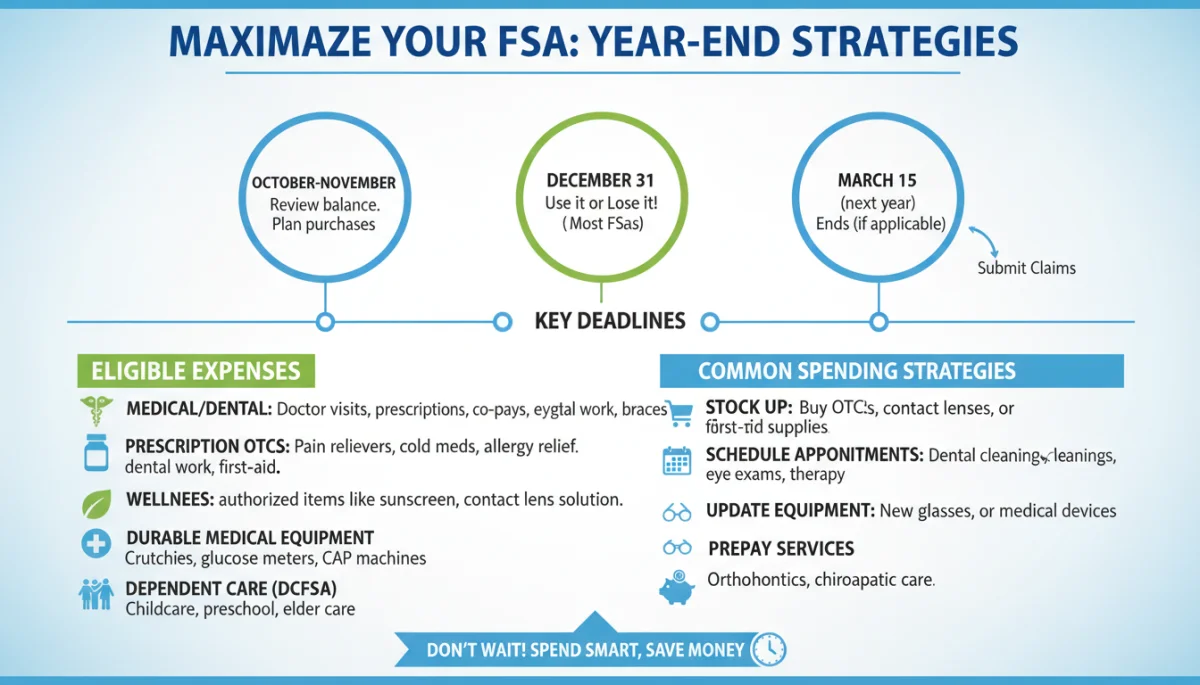
There are numerous ways to spend down your FSA balance on eligible expenses. Think creatively about your healthcare needs and those of your family. Many common items you might purchase anyway can be covered by your FSA.
- Schedule appointments: Book annual physicals, dental cleanings, eye exams, or specialist visits that you’ve been putting off.
- Stock up on eligible supplies: Purchase a year’s supply of contact lenses, prescription refills, or over-the-counter medications you regularly use (e.g., pain relievers, allergy meds, bandages).
- Invest in medical devices: Consider buying a blood pressure monitor, thermometer, or a new pair of prescription glasses.
- Elective procedures: If you’ve been considering elective procedures like laser eye surgery (LASIK) or orthodontia, the end of the year could be a good time to schedule and pay for them.
- Explore FSA stores: Many online retailers specialize in FSA-eligible products, making it easy to browse and purchase qualifying items.
Remember to keep all your receipts, as you may need them for substantiation. By implementing these year-end spending strategies, you can confidently utilize all your FSA funds, effectively maximizing your 2026 FSA benefits and avoiding the frustrating ‘use it or lose it’ trap.
Record keeping and substantiation for your FSA
While the primary focus is often on spending FSA funds, proper record-keeping and substantiation are equally critical for a smooth experience. The IRS requires that all FSA expenditures be substantiated, meaning you must prove that the expense was for an eligible medical purpose. Failing to do so can lead to funds being deemed taxable income or even repayment demands.
Maintaining meticulous records throughout the year protects you in case of an audit or if your plan administrator requests documentation. It also helps you track your spending against your balance, making year-end planning much easier. Think of it as your financial safety net for healthcare expenses.
Best practices for FSA record keeping
Developing a simple yet effective system for your FSA records can save you significant headaches down the line. Digital copies are often preferred for their ease of storage and retrieval, but physical copies are also acceptable.
- Keep all receipts: This includes itemized receipts for prescriptions, doctor visits, dental work, vision care, and any over-the-counter purchases made with your FSA card.
- Understand what’s needed: Receipts should typically include the date of service, the description of the service or item, the provider’s name, and the amount charged.
- Organize systematically: Create a dedicated folder (physical or digital) for all FSA-related documents. Sort them by date or by category for easy access.
- Review statements: Regularly check your FSA account statements against your receipts to ensure all transactions are accurately recorded and processed.
Many FSA providers offer online portals or mobile apps that can help you manage your account, submit claims, and upload receipts. Utilizing these tools can streamline the substantiation process. By adhering to these record-keeping best practices, you ensure compliance and safeguard your tax-advantaged healthcare savings, truly maximizing your 2026 FSA benefits.
| Key Strategy | Brief Description |
|---|---|
| Understand Plan Rules | Know your FSA’s specific ‘use it or lose it’ rules, including grace periods or carryover options. |
| Optimize Contributions | Estimate 2026 healthcare expenses accurately to avoid over- or under-funding your account. |
| Utilize Eligible Expenses | Familiarize yourself with a wide range of eligible items and services, including OTC products. |
| Year-End Spending | Proactively schedule appointments and stock up on supplies as the plan year concludes. |
Frequently Asked Questions About FSAs
The ‘use it or lose it’ rule states that any money remaining in your Flexible Spending Account (FSA) at the end of the plan year, or after a grace period, is forfeited. This emphasizes the importance of careful planning and spending to maximize your 2026 FSA benefits and avoid losing your contributions.
Some FSA plans offer a carryover option, allowing you to roll over a limited amount of unused funds (e.g., up to $610, adjusted annually) into the next plan year. However, this is not universal. Check with your employer or plan administrator to see if your 2026 FSA includes this feature.
Eligible FSA expenses include a wide range of medical, dental, and vision costs. This covers doctor co-pays, prescription medications, eyeglasses, contact lenses, dental work, and many over-the-counter items like pain relievers, bandages, and feminine hygiene products. Always verify with your plan specifics.
To avoid forfeiture, plan proactively. Monitor your balance, schedule necessary appointments (dentist, optometrist, annual physical) before year-end, and stock up on eligible over-the-counter items or medical supplies you regularly use. Utilize any grace period or carryover option your plan may offer.
Neither is inherently ‘better’; they serve different needs. FSAs are employer-sponsored, have a ‘use it or lose it’ rule (with exceptions), and are ideal for predictable annual healthcare costs. HSAs are individual, roll over year-to-year, and are paired with high-deductible health plans, offering long-term savings and investment potential.
Conclusion
Maximizing your 2026 Flexible Spending Account (FSA) benefits is entirely achievable with informed planning and proactive management. By understanding the basics, navigating the ‘use it or lose it’ rule with its potential exceptions, and strategically planning your contributions and expenditures, you can fully leverage the tax advantages an FSA offers. Remember to keep diligent records and utilize year-end strategies to ensure every dollar is spent on eligible healthcare needs. Taking these steps will empower you to optimize your healthcare savings and avoid leaving any hard-earned money behind.
