Maximizing Your Social Security Benefits 2026

Anúncios
Understanding and strategically claiming Social Security benefits in 2026 is crucial for U.S. retirees to optimize their financial future, requiring careful consideration of claiming age, spousal benefits, and future adjustments.
For many Americans, understanding how to maximizing your Social Security benefits in 2026: A Guide to Claiming Strategies for U.S. Retirees is a cornerstone of a secure retirement. This guide will help you navigate the complexities and make informed decisions.
Understanding Social Security Basics in 2026
Social Security remains a vital financial lifeline for millions of American retirees. As we look towards 2026, the fundamental principles largely remain, but understanding the nuances and potential changes is key to effective planning. Your benefit amount is primarily determined by your highest 35 years of earnings, adjusted for inflation.
It’s not just about when you start claiming; it’s also about understanding how your earnings history translates into a monthly payment. The Social Security Administration (SSA) provides annual statements that estimate your benefits, which are an invaluable tool for planning. Regularly reviewing these statements can help you track your progress and identify any discrepancies.
Key Factors Influencing Your Benefit Amount
Several critical factors directly impact the size of your Social Security checks. These include your lifetime earnings, your claiming age, and any cost-of-living adjustments (COLAs) applied to benefits. Each of these elements interacts to shape your ultimate retirement income from Social Security.
- Lifetime Earnings: Your average indexed monthly earnings (AIME) from your 35 highest-earning years determine your primary insurance amount (PIA).
- Claiming Age: Electing to claim benefits earlier than your full retirement age (FRA) results in a permanent reduction, while delaying past FRA increases your benefit.
- Cost-of-Living Adjustments (COLAs): Annual COLAs are designed to help benefits keep pace with inflation, though the exact percentage can vary significantly year to year.
Understanding these foundational elements is the first step toward building a robust claiming strategy. Without a clear grasp of how your benefits are calculated, it’s challenging to make strategic decisions that could significantly impact your retirement income. Staying informed about potential legislative changes is also crucial, as these can sometimes alter the landscape of Social Security benefits.
Strategic Claiming Ages: When to Start Your Benefits
The decision of when to begin receiving your Social Security benefits is perhaps the most critical choice you’ll make, with long-lasting financial implications. While you can claim as early as age 62, or as late as age 70, each option comes with its own set of advantages and disadvantages. The optimal claiming age is highly individual, depending on your health, financial needs, and other retirement income sources.
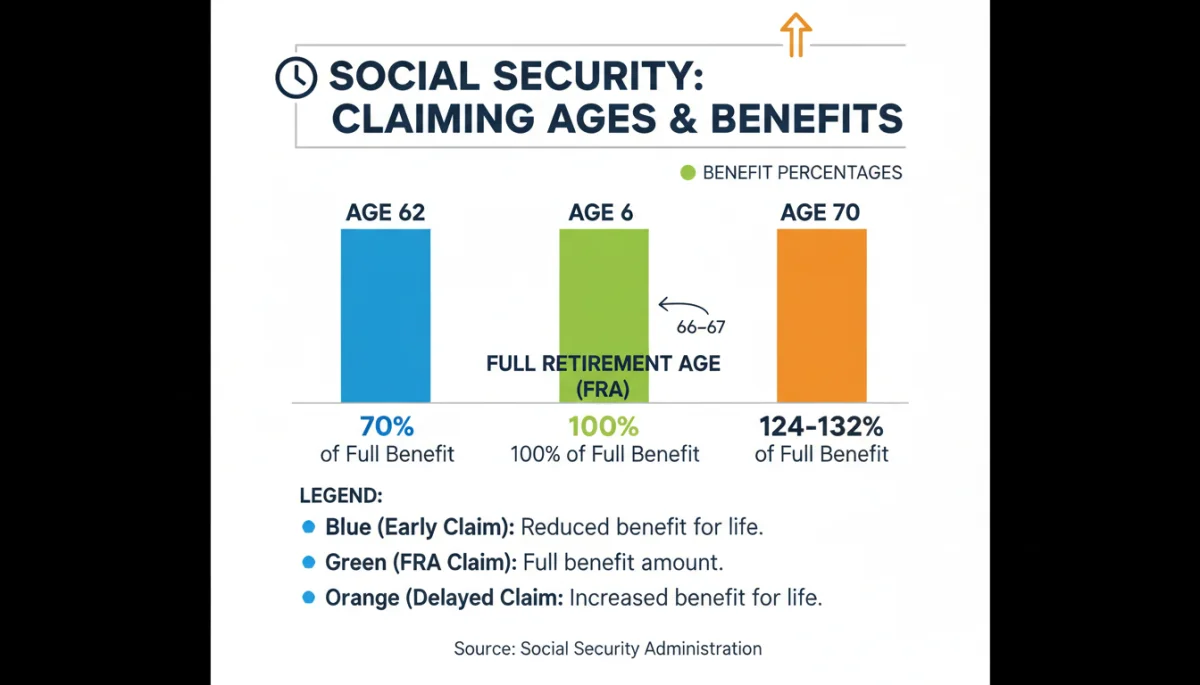
Claiming early at age 62 means you’ll receive benefits for a longer period, but each payment will be permanently reduced. Conversely, waiting until age 70 ensures you receive the maximum possible monthly benefit, but you’ll have fewer years to collect. Your full retirement age (FRA), which varies depending on your birth year, is the benchmark for receiving 100% of your primary insurance amount (PIA).
Understanding Full Retirement Age (FRA)
Your full retirement age is a crucial marker in Social Security planning. For those born in 1943 or later, FRA ranges from 66 to 67. Claiming at your FRA means you receive 100% of the benefit amount you’ve earned based on your work history. Any claim before this age results in a permanent reduction, while delaying beyond it leads to increased benefits.
- Born 1943-1954: FRA is 66.
- Born 1955: FRA is 66 and 2 months.
- Born 1956: FRA is 66 and 4 months.
- Born 1957: FRA is 66 and 6 months.
- Born 1958: FRA is 66 and 8 months.
- Born 1959: FRA is 66 and 10 months.
- Born 1960 or later: FRA is 67.
The decision to claim early, at FRA, or to delay should be carefully weighed against your personal circumstances. Factors such as your current health, family longevity, other retirement savings, and whether you plan to continue working all play a significant role in determining the best claiming strategy for you. It’s often beneficial to consult with a financial advisor to model different scenarios.
Considering Spousal and Survivor Benefits
Social Security isn’t just for individual retirees; it also provides crucial benefits for spouses and survivors. Understanding these provisions can significantly enhance a couple’s overall retirement income and provide a safety net in the event of a spouse’s passing. These benefits are designed to support families and can be a powerful tool for maximizing household benefits.
Spousal benefits allow one spouse to claim up to 50% of the other spouse’s primary insurance amount (PIA), provided certain conditions are met. Survivor benefits, on the other hand, offer financial support to a surviving spouse or dependent children after a worker’s death. Both types of benefits have specific eligibility rules and claiming strategies that can be complex but rewarding.
Maximizing Spousal Benefits
If you are married, divorced, or widowed, you may be eligible for spousal benefits based on your current or former spouse’s earnings record. A common strategy involves one spouse, typically the higher earner, delaying their benefits to age 70 to maximize their own payment, while the other spouse claims spousal benefits at their FRA. This allows the couple to receive some income while the primary earner’s benefit grows.
- Eligibility: You must be at least 62, or caring for a child under 16 or disabled.
- Benefit Amount: Up to 50% of your spouse’s PIA at your FRA.
- Impact of Early Claiming: Claiming spousal benefits before your FRA will result in a reduced amount.
For divorced individuals, you may still be able to claim benefits on a former spouse’s record if the marriage lasted at least 10 years, you are currently unmarried, and you are at least 62. This can be a significant advantage, especially if your own earnings record is lower.
Working in Retirement: Impact on Your Benefits
Many individuals choose to work part-time or full-time in retirement, whether for financial reasons or personal fulfillment. While working can provide additional income, it’s crucial to understand how your earnings can affect your Social Security benefits, especially if you claim before your full retirement age. The earnings test is a key factor to consider.
If you are below your full retirement age and earn above a certain annual limit, the SSA will temporarily withhold a portion of your benefits. This isn’t a permanent loss, as your benefit amount will be recalculated at your FRA to account for the withheld funds. However, it’s a critical consideration for those who plan to work and claim early.
The Social Security Earnings Test
The earnings test applies only if you are working and claiming Social Security benefits before your full retirement age. In the year you reach FRA, a different, higher earnings limit applies. Once you reach your FRA, the earnings test no longer applies, and you can earn as much as you like without impacting your benefits.
- Before FRA: For every $2 you earn above the annual limit, $1 is deducted from your benefits.
- In the year you reach FRA: For every $3 you earn above a higher annual limit, $1 is deducted from your benefits, only counting earnings before the month you reach FRA.
- At or After FRA: No benefits are withheld due to earnings.
Careful planning is essential if you intend to work while receiving benefits. Understanding these thresholds can help you manage your income and optimize your combined earnings from work and Social Security. It’s advisable to check the SSA website for the most current earnings limits, as these are subject to annual adjustments.
Understanding Cost-of-Living Adjustments (COLAs)
Cost-of-Living Adjustments, or COLAs, are a critical component of Social Security, designed to help benefits keep pace with inflation. These annual adjustments ensure that the purchasing power of your Social Security checks doesn’t erode over time due to rising costs. While COLAs are not guaranteed to occur every year, they have been a regular feature of the program.
The COLA is determined by the increase in the Consumer Price Index for Urban Wage Earners and Clerical Workers (CPI-W) from the third quarter of the previous year to the third quarter of the current year. If there is no increase, there is no COLA. This mechanism aims to maintain the real value of benefits for retirees and other beneficiaries.
How COLAs Impact Your Long-Term Benefits
COLAs can significantly impact the cumulative value of your Social Security benefits over your retirement. Even small annual increases can add up over decades, providing a substantial boost to your overall financial security. For example, a 2% COLA on a $1,500 monthly benefit means an extra $30 per month, which translates to $360 per year.
- Maintaining Purchasing Power: COLAs help protect retirees from the effects of inflation, ensuring their benefits can still cover essential living expenses.
- Cumulative Growth: Over a long retirement, even modest COLAs can lead to significant increases in total lifetime benefits received.
- Unpredictability: While COLAs are common, their size is unpredictable and depends on economic factors, making precise long-term planning challenging.
While COLAs are a welcome feature, it’s important to remember that they are reactive, not proactive. They reflect past inflation, meaning there’s often a lag before beneficiaries feel the full benefit of the adjustment. Nonetheless, they are a vital safeguard for the long-term financial health of Social Security recipients.
Future Outlook and Planning for 2026 and Beyond
As we plan for 2026 and the years that follow, it’s important to consider the broader outlook for Social Security. While the program faces long-term financial challenges, it’s crucial to remember that Social Security has a strong foundation and is projected to be able to pay a significant portion of promised benefits for decades to come. Understanding these projections can help manage expectations and inform your personal financial planning.
Ongoing discussions about potential reforms, such as adjustments to the full retirement age, changes to the COLA calculation, or modifications to the earnings test, are part of the political landscape. While the precise nature of any future changes is uncertain, staying informed about these debates can help you adapt your strategies as needed. It’s always wise to build a diversified retirement plan that doesn’t solely rely on Social Security.
Diversifying Your Retirement Income
While Social Security is a crucial component of most retirement plans, it should ideally be part of a broader financial strategy. Relying solely on Social Security benefits can leave retirees vulnerable to unexpected expenses or economic downturns. A diversified approach typically includes a mix of savings, investments, and potentially other income streams.
- Personal Savings: Building a robust personal savings account or emergency fund provides a buffer for unforeseen costs.
- Investment Accounts: Utilizing 401(k)s, IRAs, and other investment vehicles can provide significant growth and income in retirement.
- Other Income Streams: Pensions, part-time work, or rental income can supplement Social Security benefits and enhance financial security.
By taking a proactive approach to your retirement planning, including understanding and optimizing your Social Security benefits, you can build a more resilient financial future. Consulting with a qualified financial advisor can provide personalized guidance and help you navigate the complexities of retirement income planning effectively.
| Key Strategy | Brief Description |
|---|---|
| Delay Claiming | Waiting until age 70 can increase your monthly benefit by up to 8% per year past your Full Retirement Age. |
| Spousal Benefits | Explore claiming benefits based on a spouse’s or ex-spouse’s record, potentially up to 50% of their PIA. |
| Work Past FRA | Avoid the earnings test and potentially increase your average indexed monthly earnings by working beyond your Full Retirement Age. |
| Review Earnings Record | Regularly check your Social Security statement for accuracy, as errors can impact your future benefit calculations. |
Frequently Asked Questions About Social Security Benefits
The optimal age to claim Social Security benefits varies per individual. While claiming at age 70 maximizes monthly payments, starting at your Full Retirement Age (FRA) provides 100% of your earned benefits. Early claiming at 62 results in a permanent reduction. Consider your health, other income, and financial needs carefully.
If you work and claim benefits before your Full Retirement Age, your benefits may be temporarily reduced if your earnings exceed annual limits. Once you reach your FRA, the earnings test no longer applies, and you can earn as much as you want without impacting your Social Security payments.
Yes, you may be able to claim benefits on a former spouse’s record if your marriage lasted at least 10 years, you are currently unmarried, and you are at least 62 years old. This can be a valuable option, especially if your own earnings history is lower.
COLAs are annual adjustments to Social Security benefits designed to help them keep pace with inflation. The adjustment is based on the Consumer Price Index for Urban Wage Earners and Clerical Workers (CPI-W) and aims to preserve the purchasing power of your benefits over time.
Absolutely. Social Security claiming strategies can be complex, especially with spousal or survivor benefits, or if you plan to work in retirement. A qualified financial advisor can help you analyze your unique situation, model different scenarios, and develop a personalized strategy to maximize your lifetime benefits.
Conclusion
Navigating the intricacies of Social Security benefits in 2026 requires careful consideration and strategic planning. By understanding your Full Retirement Age, evaluating the impact of different claiming ages, and exploring potential spousal or survivor benefits, U.S. retirees can significantly enhance their financial security. Furthermore, being aware of how working in retirement affects benefits and the role of Cost-of-Living Adjustments is crucial for long-term financial health. Ultimately, a well-thought-out Social Security strategy, often developed with professional guidance, is an indispensable component of a successful retirement plan.
